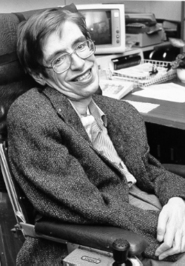
201 Published BooksStephen W. Hawking
Stephen William Hawking (1942–2018) was an English theoretical physicist, cosmologist, and author. He served as Director of Research at the Centre for Theoretical Cosmology at the University of Cambridge. From 1979 to 2009, he held the position of Lucasian Professor of Mathematics at Cambridge, widely regarded as one of the most prestigious academic appointments in the world.
Early life and education
Hawking was born in Oxford, England, into a family of physicians. In October 1959, at the age of 17, he began his university education at University College, Oxford, where he graduated with a first-class degree in physics. In October 1962, he began postgraduate studies at Trinity Hall, Cambridge. He received his PhD in applied mathematics and theoretical physics in March 1966, specialising in general relativity and cosmology.
In 1963, at the age of 21, Hawking was diagnosed with an early-onset, slowly progressing form of motor neurone disease. The condition gradually paralysed him over several decades. Following the loss of his ability to speak, he communicated using a speech-generating device, initially operated by a handheld switch and eventually controlled by a single cheek muscle.
Scientific contributions
Hawking made groundbreaking contributions to theoretical physics and cosmology. His scientific work included a collaboration with Roger Penrose on gravitational singularity theorems within the framework of general relativity, as well as his theoretical prediction that black holes emit radiation, now known as Hawking radiation. Initially controversial, this prediction became widely accepted as a major breakthrough in theoretical physics.
He was also the first to formulate a theory of cosmology based on the combination of general relativity and quantum mechanics. In addition, he was a prominent supporter of the many-worlds interpretation of quantum mechanics.
Publications and recognition
Beyond his scientific research, Hawking achieved international recognition through his popular science books, in which he made complex theories and questions about the universe accessible to a wider audience. His best-known work, A Brief History of Time, became an international bestseller and remained on the Sunday Times bestseller list for a record-breaking 237 weeks.
Hawking was a Fellow of the Royal Society, a lifetime member of the Pontifical Academy of Sciences, and a recipient of the Presidential Medal of Freedom, the highest civilian honour in the United States. In 2002, he was ranked 25th in the BBC's poll of the 100 Greatest Britons.
Stephen Hawking died in Cambridge on March 14, 2018, at the age of 76, having lived for more than 50 years following his diagnosis of motor neurone disease.